

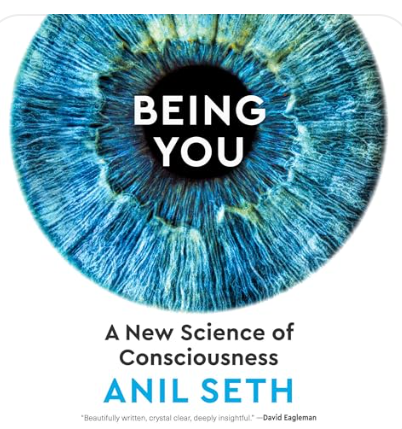
8/2026 Being You: A New Science of Consciousness, by Anil Seth
Why would anyone read a book on consciousness? Well, like elbows and social security numbers, we all got one. And what I’ve been taught about consciousness doesn’t hold up scientifically. Take Descartes. His 17th -Century Mind/Body dualism doesn’t hold up under scientific scrutiny, according to Seth. Seth updates Descartes’ famous “I think, therefore I am,” to “I predict (myself) therefore I am.”
That’s because the author sees the brain as a prediction machine. It takes the chaotic information of daily existence and makes guesses about it, and that is our reality. So, we’ll use your red patio chair as an example. It’s not red. We perceive cues that what we’re looking at matches what our brain considers to be “redness.” The redness, like many other things, are just in our heads. Much of what Seth discusses is based on mathematical theory created by Thomas Bayes in the 1700s. Bayes’ theorem is useful to know in our technology-driven world. https://en.wikipedia.org/wiki/Bayes%27_theorem
Like many other scientific books (for example those by Richard Dawkins), Being You contains some really mind-blowing facts. Fear is created not by finding a giant bear standing before you, but by your reaction to that bear (like fleeing). The Rubber Hand experiment proves that we may be deceived about what is and what is our own bodies. https://www.youtube.com/watch?v=sxwn1w7MJvk And, if you’re interested in alternate states of consciousness, alien states of consciousness if you will, read Seth’s discussion near the end of his book on Octopi. They are able to transform their bodies into three different colors, and do so unconsciously. On top of that, they’re color-blind. Their consciousness is not at all like ours. And it may be that severed parts of octopi retain consciousness. Nevertheless, they problem-solve like humans and in labs even show interest in what the experimenter happens to be doing.
Seth’s take on whether machines will ever develop consciousness? He says it depends on your definition, but overall he is doubtful. It’s comforting to know that that AI agent at the Verizon help desk most likely isn’t plotting global annihilation.
* * * * *
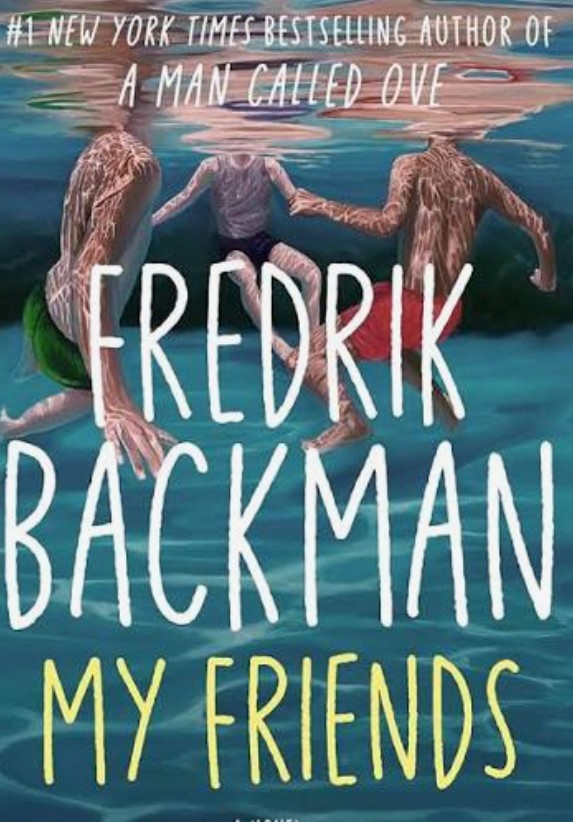
8/29/26 My Friends, by Fredrik Backman
Throughout this brilliant, one-of-a-kind novel the friends in it say, “I love you and I believe in you.” What else can be said about Fredrik Backman and My Friends? I love this author and I believe in him. I love My Friends and I believe it it’s world.
This is not a perfect novel. However, you will feel more than you’ve ever felt while reading a book. More than when reading Dostoyevsky. Much more than from reading Shakespeare. If novels are all about feelings, Backman is king of the form.
Rather than blather on, here’s some aphorisms from My Friends. I hope they whet your appetite for more. The novel’s packed with them.
* * *
18-year-old Louisa, a budding artist, has somehow been given a priceless painting. She talks with an acquaintance about what to do with it.
“You can buy it from me.”
Ted can’t help smiling at this.
“I can’t afford it, my dear.”
“Aren’t you rich?” She exclaims, glancing at his clothes as if everyone with clean pants must be financially independent.
“I’m a high school teacher,” T. Ted informs her.
* * *
It’s hard to say I love you when you’re 14 years old. And completely impossible to dare to whisper: “Don’t hurt yourself, because you’d be hurting me too.”
* * *
The acquaintance, Ted, taught high school. He was stabbed in the classroom. Discussing the incident, Ted says:
“It isn’t a teacher’s job to protect their students,” he mumbles, not that he believes that, but because he heard a colleague say it once.
“Yes it is,” she replies calmly.
* * *
“No one teaches anyone to paint, all we learn are rules and limitations, what we aren’t supposed to do. I went to art school, but I was lucky, I got thrown out before they had time to teach me anything.”
* * *
“Art is what we leave of ourselves in other people.”
* * *
“Isn’t it like, totally unbelievable that we even exist? So it won’t be a tragedy when we don’t exist anymore! It’s just cool, really cool, that we happened at all.”
* * *
Throughout our entire existence we have been on the run, first from wild animals, then from each other.
* * *
“It’s hard to be little.”
“It’s hard to be everything.”
“Yes. That’s true. It’s hard to be everything.”
* * *
“Thank goodness, you haven’t had any training! No one who’s had any training paints like that! Art doesn’t require training, dear child, art just needs friends.”
* * *
Christian’s mother … quotes a poet: Thomas Transtromer: “Don’t be ashamed to be a human being—be proud. Inside you one vault after another opens endlessly. You will never be complete, and that’s how it should be.”
* * *
Near the end of the novel, Louisa and Ted are talking.
“Kimkim used to sit in a window looking down at the street and ask how everyone else could bear to be human.”
“What did you tell him?” Louisa asks.
“I said that maybe we could learn how.”
“Have you figured it out yet?”
“Maybe I’m on my way. That’s all anyone can be.”